homeprint this pagebookmarksend to a friendsite map
Scope of Services

The Detroit Institute for Children (The DIC) provides services to children and adolescents with special health care needs. Patients are between the ages of birth – 18 years old and should be medically stable. Exceptions may be made for older individuals with disabilities on a case-by-case basis, who require specialized evaluations or equipment such as Seating, Mobility or other Activity of Daily Living needs. Services are dedicated to improve both activity limitations and participation restrictions.

All services are offered on an outpatient basis because all of our patients live in their home environments. The intensity of the services is based on the individual needs of each patient. Services may continue for as long as treatment is indicated and the patient is making progress toward goals.

Admission criteria – Each patient must have a valid prescription, and a referral or authorization if required by their insurance company. Additionally, an evaluation and treatment recommendations indicating the type and frequency of treatment is also required. For rehabilitation services, patients should have a condition or disability resulting in short-term or chronic functional limitation.

Discharge criteria – Patients are discharged from Rehabilitation Services for several reasons, including the successful completion of treatment goals to age-appropriate level or to level of maximum function. If a patient has made limited or no progress toward their goals in a two month time period, they will be discharged from therapy. Additionally, patients may be discharged from services at the family’s request, or if they do not adhere to the attendance policy.

The DIC is a multi-service outpatient setting, and services are provided Monday through Thursday from 7:00 am to 7:00 pm, and from 7:00 am to 1:00 pm on Fridays. The DIC is closed on weekends and holidays.

REHABILITATION SERVICES

The Rehabilitation Services Department is comprised of Physical Therapy, Occupational Therapy, Speech/Language Pathology and their subspecialties. Rehabilitation professionals provide evaluations, direct therapeutic treatment services, training, and equipment recommendations.

The focus of treatment is to facilitate the attainment of a child’s maximum potential for age-appropriate, independent function in the areas of gross and fine motor skills, mobility, activities of daily living, and communication. These goals are achieved through direct therapeutic treatment sessions or modalities, parental/caregiver training, and fabrication of or recommendations for appropriate equipment to enhance or substitute for lack of functional ability.

Physical Therapy

Licensed physical therapists evaluate and establish treatment programs for children, focusing on postural control, movement patterns, balance, coordination, flexibility, mobility, strength and gross motor skill. Staff uses specialized treatment approaches and modalities including Neurodevelopmental Treatment to reach their patient’s goals. The staff includes input from parents/caregivers in developing individualized treatment plans that maximize each child’s potential for functional independence.

Occupational Therapy

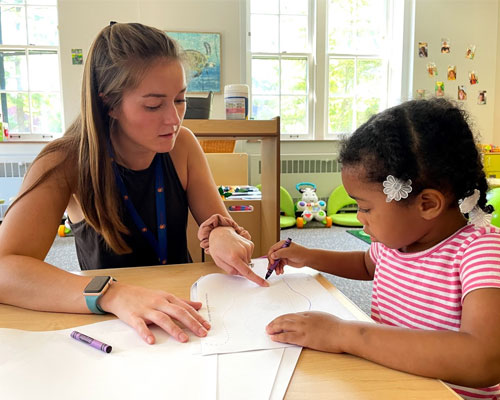
Registered occupational therapists evaluate and establish treatment programs for children, focusing on fine motor skills, self-care activities (including feeding, dressing and bathing), coordination, visual motor skills and sensory processing dysfunction.

Speech/Language Pathology

Certified speech/language pathologists evaluate and treat patients in the areas of auditory comprehension, expressive communication, social language, speech production, oral motor weakness and feeding/swallowing. Therapeutic programs are individualized to maximize speech, language, and communication skills.

Serial Casting

Serial casting is a method used by specially trained physical and occupational therapists, to increase the range of motion (ROM) in tight or contracted muscles and to inhibit muscle tone. Limitations in upper and lower extremity ROM that impair orthotic fit, hand function or gait are addressed by the occupational or physical therapist. Orthotic or splinting devices are frequently used after the casting series is completed to assist in maintaining achieved ROM, standing, walking or hand function. Serial casting is often performed in conjunction with Botox or alcohol blocks to decrease spasticity.

Splinting

Registered occupational therapists evaluate for appropriate splint us to facilitate improved hand function, prevent or decrease contractures and deformities, and inhibit spasticity. Occupational therapists will either fabricate custom splints for upper extremities or assess appropriateness for commercially available splints.

ASSISTIVE TECHNOLOGY SERVICES

Activities of Daily Living (ADL) Clinic

ADL Clinic provides a mechanism for evaluation and selection of equipment to help the child and caregiver gain independence and safety in feeding, dressing, toileting, bathing, personal hygiene, and other daily care needs. A multitude of both high technology and simple devices are available to assist children with disabilities and their caregivers gain control of their environment. Through the ADL Clinic each child is evaluated to determine the specific design and model of equipment to most appropriately meet their individual needs.

Seating and Mobility Clinics

Recommendations are made for the individual child's specific mobility equipment and coordinating seating system. All necessary documentation is provided and on-going mobility training is available to facilitate improved proficiency in operating switches and in maneuvering safely in both indoor and outdoor environments. The Mobility Clinic also evaluates individuals for specialized standing equipment, adapted tricycles and other mobility equipment. The DIC therapists have specialized training and experience in simple to highly complex mobility systems.

Postural, orthopedic and functional abilities of children and young adults are evaluated by a therapist who specializes in adaptive seating, in consultation with a physician, as needed. A wide array of seating components is considered in developing a recommendation for a customized seating system for each individual. Therapists also evaluate for equipment to facilitate a means of mobility. Emphasis is placed on the individual's physical and cognitive ability to operate a power wheelchair/mobility device.

ORTHOTICS

In cooperation with Wright and Filippis, high quality, custom-made orthoses are available on-site at The DIC. By using a team approach, the orthotist consults with the physician, therapist(s), and caregivers to evaluate the status and needs of the patient and ultimately design the most appropriate orthotic device. The goal of the orthotics department is to design and fabricate the best possible device to improve biomechanical alignment, prevent deformity and improve the child’s ability to stand and walk. Many orthotic designs and components are available, with each brace being individually selected and customized to meet each patient’s needs.

CLINIC SERVICES

The Clinic Services Department offers specialty health care for children and young adults with special needs. Care is provided by an exemplary staff of pediatric specialists including a pediatric nurse practitioner. The clinical services encompass a wide variety of medical specialties including Physical Medicine and Rehabilitation, Botox, Neurology, and Child and Adolescent Psychiatry.

Physical Medicine and Rehabilitative Clinic (PM&R)

Evaluation and treatment are provided by a board-certified pediatric PM&R physician. The clinic focuses on the rehabilitation of developmentally disabled children through non-surgical approaches. The PM&R physician will evaluate the child and develop a plan of care with the parents through diagnostic, therapeutic, and management procedures. The PM&R physician works closely with occupational, physical and speech therapists to coordinate children's rehabilitation programs and orders specialized equipment to assist children. Spasticity management is important and can be done in a variety of ways including oral medications and botulinum toxin (Botox) injections.

Botox Clinic

Botox injections are done to reduce spasticity, pain and drooling. Injections are done by a board certified Physical Medicine and Rehabilitation doctor. Injections are commonly done before serial casting so the children's muscles are relaxed in the casts, and they are more comfortable. Botox injections promote easier movement, easier care and less pain for our children. Ultrasound-guidance is used for specific muscles and for salivary glands.

Neurology Clinic

A board-certified pediatric neurologist provides diagnostic evaluations for children with suspected neurological problems. A certified pediatric nurse practitioner is available for further coordination of care. Children with neurological problems will receive a treatment plan of care and monitoring of their condition. Children with a variety of diagnoses are seen, including epilepsy, autism spectrum disorder, attention deficit disorder, specific learning difficulties, language processing, sensory processing dysfunction, and behavioral difficulties. Information requested from parents and teachers is always included as part of the evaluation.

Child and Adolescent Psychiatry

Psychiatric services are offered to patients at The DIC with psychiatric difficulties, in addition to their developmental disabilities. Services are provided by a board-certified child/adolescent psychiatrist. Services are limited and available upon referral only. Psychotropic medication reviews are offered to patients after an initial psychiatric and/or neurological evaluation.

Nursing

The nursing staff provide on-site and telephone consultation relating to the client’s medical care and management, answering questions regarding seizure management, medications, prescription renewals, laboratory studies, and patient behavior problems. Parent education is provided on a variety of medical topics and procedures.

Lab Services

In coordination with the Detroit Medical Center, The DIC provides lab services during limited hours. During operating hours, patients can come in and have blood testing done. Families need to bring a copy of the patient’s current insurance and the physician’s prescription for the lab test.

SCHOOL SERVICES

Through our contracted pediatric therapy services, we are able to provide direct treatment, consultation and evaluation, as well as staff/teacher in-services on-site to schools and agencies for children with special needs. Our staff serve children enrolled in all special education programs from Early Intervention to the high school level throughout Wayne, Oakland and Macomb counties.

For over 20 years, physical, occupational and speech therapists, psychologists, and social workers, have been contracted out to various school districts, charter schools, and Head Start programs.

Contracted school services have certain advantages for the schools and the children they serve:

· Therapists who have experience, education, and training in working with children provide services.

· Staffing schedules based on the contracting agency’s specific needs.

· Management and human resource expenses are eliminated for the contracting agency.

· Quality of care is assured by our licensed and certified therapists, who provide ongoing in-services and opportunities for continuing education.

Contracted services are often a desirable option for the education administrator. Schools receive quality therapy services, contain costs, and simplify management. The Detroit Institute for Children is able to assist in filling full and part time positions, maternity and medical leaves, unexpected vacancies during the school year, and any other openings that may require therapy services. Our services are individually designed to meet the needs of the contracting agency and are provided on an hourly rate basis.